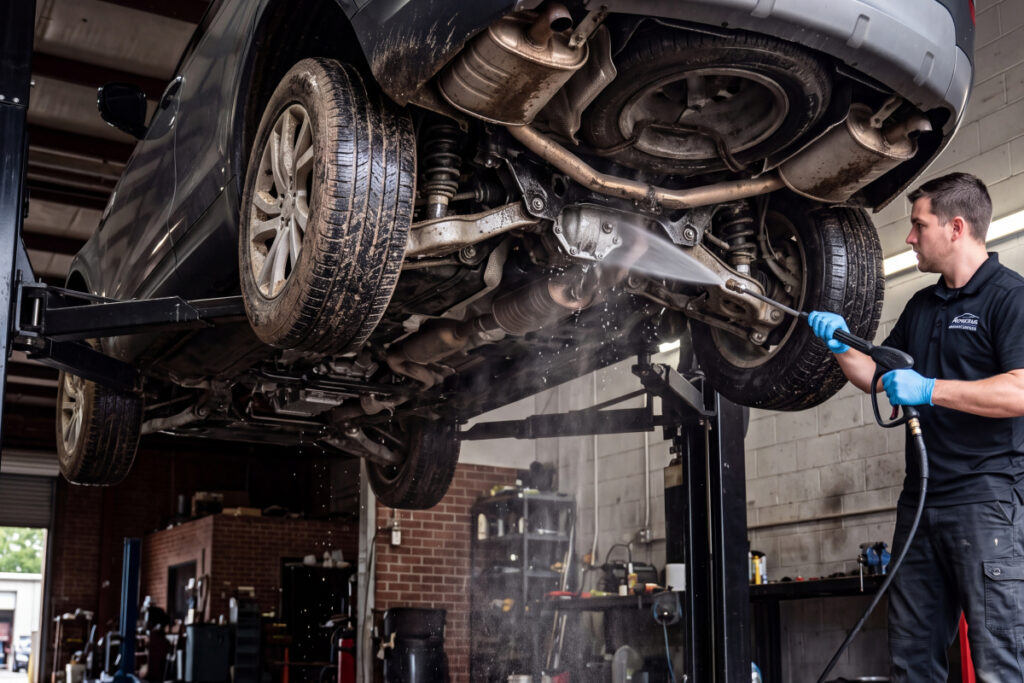
Undercarriage wash, sometimes called an undercarriage wash or underbody wash, is the high-pressure cleaning of the underside of a vehicle, covering the frame rails, suspension components, exhaust system, fuel and brake lines, floor pans, and wheel wells from below. Most vehicle owners never see these surfaces directly, which is exactly why they accumulate road grime, salt residue, and mud at a rate that the rest of the vehicle does not. Chesapeake drivers face a coastal environment where dissolved salt from the Bay watershed deposits on the underbody every time a vehicle drives through treated roads or near the waterway corridors. That salt stays there until it is physically washed off, and while it sits, it attacks bare metal.
What Our Undercarriage Wash Covers
The Hampton Roads area sits at the intersection of several salt sources that most inland drivers never deal with simultaneously. Virginia DOT treats the Chesapeake Expressway, I-64, Route 168, and the Hampton Roads Bridge-Tunnel approach roads with road salt and brine during winter weather events, which coats the underbody of every vehicle that drives on those routes. The Elizabeth River corridor, Back Bay, and the Chesapeake Bay waterway introduce salt air and tidal salt spray that settles on everything below the rocker panels. Vehicles parked near the water in neighborhoods like Deep Creek, Portlock, and Churchland accumulate this salt passively even without driving on treated roads. Once on the metal, salt begins electrochemical corrosion within hours of contact.
What makes salt removal from undercarriage surfaces so time-sensitive is the rate at which chloride-induced rust progresses on bare steel. A frame rail or brake line bracket that has been salt-contaminated and left unprotected for one winter season will show measurable surface rust. After two to three winters without underbody cleaning, that surface rust begins working into the metal rather than sitting on top of it, and at that point the damage is structural rather than cosmetic. Vehicle undercarriage cleaning before and after the winter salt season is the intervention that keeps the corrosion in the surface category rather than the structural one. Chesapeake drivers who make this a twice-yearly habit extend the working life of their vehicles measurably.
The undercarriage wash process begins at the wheel wells, where the most aggressive accumulation of mud, tar, and salt saturated debris concentrates behind the tires. The wheel wells on a Chesapeake vehicle that has been driven through any unpaved area or during winter road conditions carry compacted debris that a standard car wash rinse does not move. We clear the wheel wells first with targeted high pressure water before moving to the underbody, because debris loosened from the wheel wells during the undercarriage cleaning phase can redeposit on surfaces that have already been cleaned if the sequence is wrong.
The main underbody wash and undercarriage dirt removal process uses a specialized undercarriage pressure washing wand that reaches the full width of the vehicle from multiple angles. The frame rails, suspension geometry components, and brake line routing are all accessible from below, and we work methodically from front to rear so that loosened road grime removal debris flows toward the rear of the vehicle rather than back onto cleaned surfaces. For vehicles with significant salt buildup from winter driving, a pre-spray with a salt neutralizing solution is applied before the pressure rinse to chemically break the salt bond before mechanical water pressure removes it.
Trucks and SUVs with off-road use or significant highway accumulation often have sections of the underbody where petroleum-based road film has combined with dust and grit to create a bonded layer that water pressure alone cannot remove. These areas, typically concentrated around the differential, the transmission crossmember, and the rear suspension mounts, receive a dedicated underbody cleaning degreaser before the pressure rinse stage. The degreaser breaks the hydrocarbon bond in the accumulated film, and the subsequent pressure wash then clears it from the surface completely rather than redistributing it.
After the undercarriage rinse is complete, we perform a visual inspection of the accessible underbody surfaces for areas of active rust, damaged underbody coating, exposed bare metal at welds or drill points, and any fluid leaks that become visible once the grime is removed. This inspection step is one of the most practical benefits of professional undercarriage cleaning because a vehicle’s underbody in Chesapeake’s environment will develop vulnerabilities that are invisible until the accumulated layer is washed away. We communicate what we find before the vehicle leaves so the owner can prioritize any rust protection or additional underbody coating work that the inspection reveals.
The underside of a vehicle operating in Chesapeake’s coastal environment takes more punishment per mile than almost any other surface on the vehicle. Salt deposits, road grime, tidal spray, and winter treatment chemicals accumulate on every frame rail, suspension component, and brake line on the underbody. Undercarriage wash in Chesapeake, VA from Redemption Auto Detailing removes that accumulation with proper pressure washing technique, targets heavy deposits with dedicated degreasing where needed, and finishes with an underbody inspection that tells you what is actually happening below the rocker panels. Book your undercarriage cleaning today and protect what you cannot see.
Yes. Professional undercarriage pressure washing uses controlled water pressure directed to clean surfaces rather than to force water into components. Modified suspension and aftermarket exhaust systems have the same underbody exposure as stock components and accumulate salt and road grime at the same rate. We adjust pressure and angle around any components that the owner identifies as sensitive before we begin, and we inspect the vehicle with the owner present if there are specific concerns about particular modifications.
Partially. Automated car washes with undercarriage rinse systems spray water upward from fixed nozzles, which reaches the floor pan and lower frame areas but misses the wheel wells, the suspension geometry, the brake and fuel lines along the inner frame, and the rear axle and differential areas on trucks and SUVs. A professional under vehicle wash uses a hand-held wand that covers every angle and follows the specific routing of each vehicle's underbody components. For light maintenance between professional services, an automated rinse is useful. For actual salt removal from undercarriage surfaces and road grime removal from complex geometry, it is not a substitute.
Most standard vehicles take 30 to 45 minutes for the complete underbody wash including wheel wells, pre-spray where needed, pressure rinse, and post-wash inspection. Trucks and SUVs with larger underbody surface area or significant off-road accumulation run closer to 60 minutes. The service can be combined with an exterior wash or a full detail in the same visit.